Fire / Hawick
A bakery exploded. A man died next door. Thirteen hours vanished from the official record.
A burst gas pipe tore through Trey's Bakery, dropped its roof and pushed fire into Yaya's Dance Studio. The fire marshal called it an accident ten days later—but its incident time conflicts with the fire department's record by nearly thirteen hours.
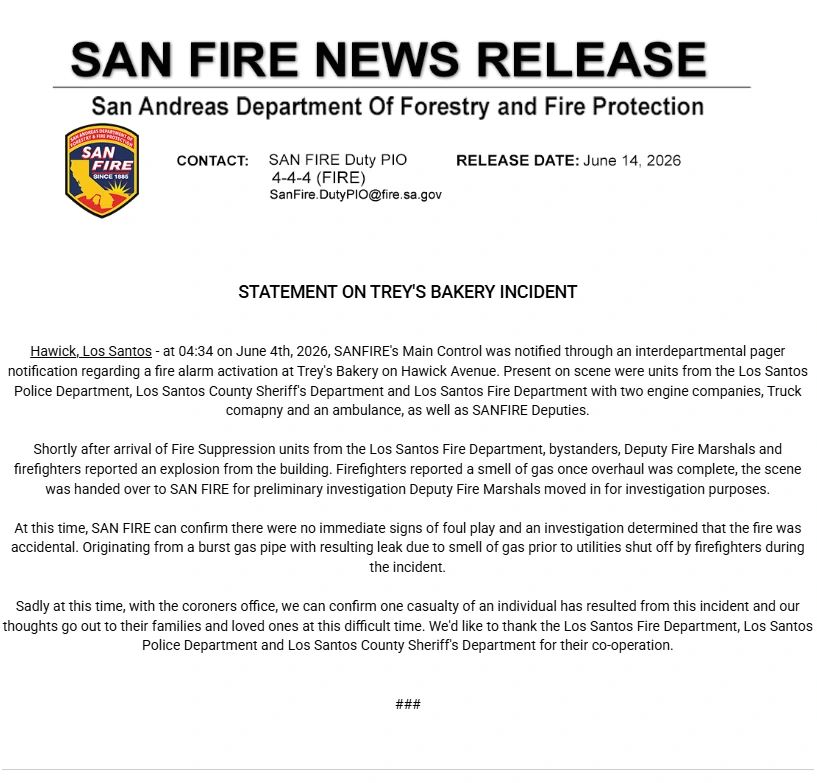
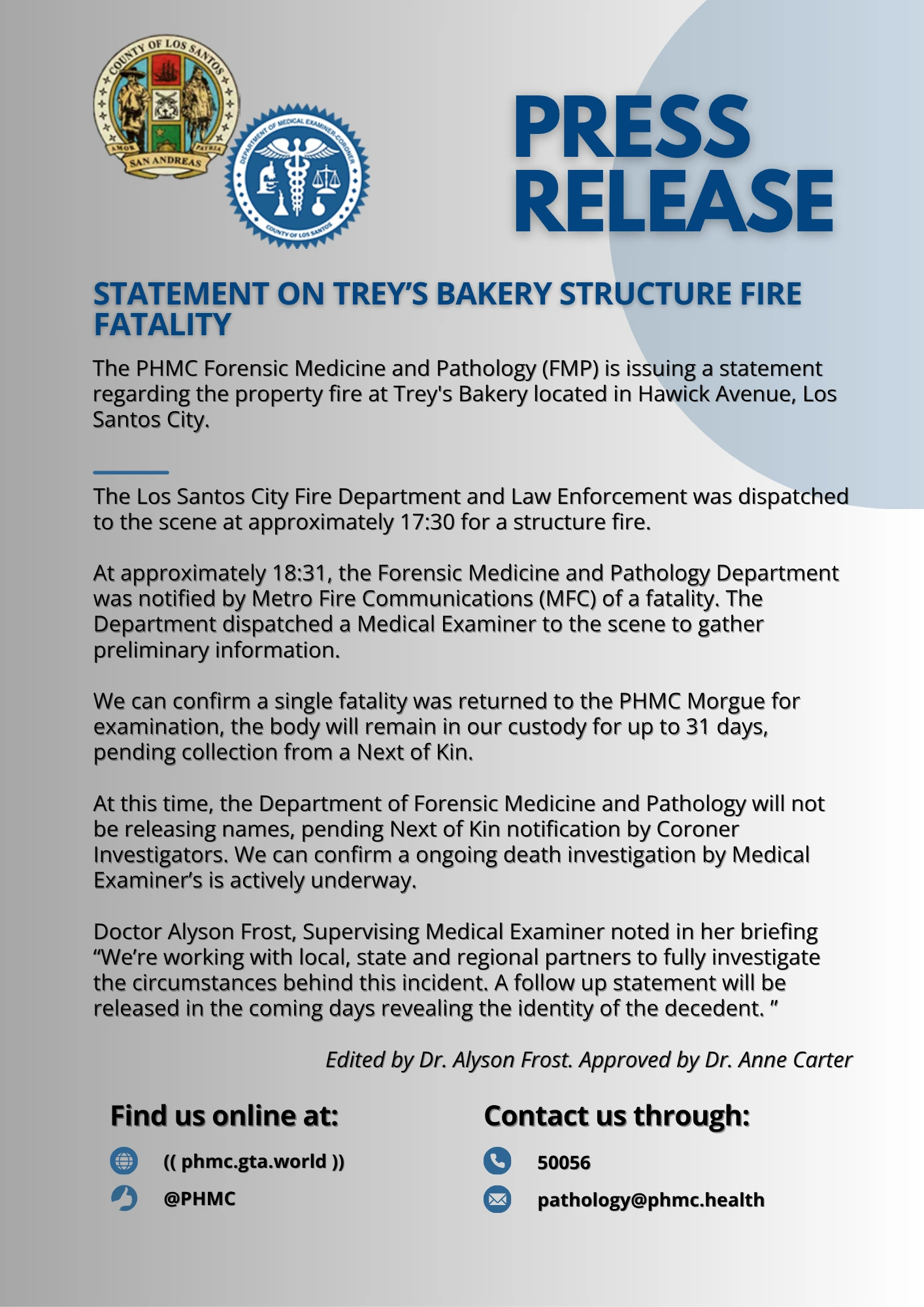
The first public account says the alarm arrived at 5:30 on a Thursday afternoon. Firefighters reached Hawick Avenue to find Trey's Bakery burning through the roof, two neighboring businesses exposed and witnesses describing an explosion violent enough to throw glass into two people. Before the hour was over, the bakery roof had collapsed and a man pulled from the dance studio next door was dead.
Los Santos Fire Department records place the automatic alarm at 5:30 p.m. on June 4. Crews from Fire Station 52 in Rockford Hills and Fire Station 9 in Davis arrived within minutes. Roughly fifteen firefighters were assigned to a fire threatening three connected businesses.
Firefighters entered for a primary search and an interior attack. Conditions deteriorated quickly. Gas monitors warned of a possible leak, utilities were cut and commanders withdrew crews before the roof came down. No firefighter was beneath it when it collapsed.
Crews kept the flames out of Lucky Strike on the bakery's east side. They could not stop the fire from entering Yaya's Dance Studio to the west. Firefighters found a man inside the studio as the fire spread, carried him outside and turned him over to paramedics. He died at the scene.
LSFD says the dance-studio fire and the main bakery blaze were extinguished by 6:08 p.m. Pillbox Hill Medical Center's Forensic Medicine and Pathology department says Metro Fire Communications notified it of the fatality at about 6:31. A medical examiner went to Hawick, and the body was taken to the county morgue while investigators attempted to notify the man's family.
The PHMC statement was edited by supervising medical examiner Dr. Alyson Frost and approved by Dr. Anne Carter. It withheld the man's name pending next-of-kin notification and promised a follow-up identifying him. PHMC's public notices contain no follow-up identifying him.
Ten days later, the state fire marshal supplied the cause that the first reports could not. SAN FIRE said deputy fire marshals found no immediate sign of foul play and determined that the fire was accidental. Its statement attributed the incident to a burst gas pipe and resulting leak. Firefighters and bystanders reported smelling gas after the explosion, according to that release.
That should have closed the broadest question—accident or attack. It opened a narrower one because SAN FIRE's statement places its first interdepartmental pager notification at 4:34 a.m. on June 4. LSFD and the medical examiner place the fire and death response around 5:30 and 6:31 p.m. The two starting times are twelve hours and fifty-six minutes apart. Both cannot describe the same initial alarm correctly.
The agencies also disagree on the bakery's name. PHMC's forum title calls it Frey's Bakers; the statement image calls it Trey's Bakery, matching LSFD and SAN FIRE. That spelling error is minor. The thirteen-hour conflict is not. The incident clock governs the sequence from alarm and evacuation to collapse, rescue and fatality notification.
A mistaken conversion from 4:34 p.m. to 4:34 a.m. is the obvious explanation. No agency has issued that correction. Until one does, the state's cause report and the city's response report remain thirteen hours apart on the start of a fatal fire.
The missing documents matter more than the press copy. A complete fire report should establish the first call, arrival times, utility shutoff, interior withdrawal, roof collapse, victim removal and transfer of the scene. The fire-marshal report should identify where the pipe failed, what appliance or line was involved, whether the system had been inspected and what evidence excluded deliberate damage. The property record should show who maintained the gas system and when.
By calling the fire accidental, SAN FIRE ruled out deliberate ignition. It did not clear the building's maintenance, ownership or inspection history. A burst gas pipe has a location, an age and a service record. Those records will show whether the failure was unforeseeable or neglected.
One man died after a gas-fed fire escaped the bakery, collapsed its roof and entered the business next door. Calling the fire accidental settles intent, not responsibility. Who maintained the pipe that burst, when was it last inspected, and why do the official clocks still differ by thirteen hours?